Firmware updates can change much more than the interface of an ASIC miner. They may affect performance profiles, power behavior, hardware compatibility, pool settings and the way a control board communicates with the rest of the machine. Updating one miner is relatively easy to supervise because the operator can watch the device through every stage of the process. Updating dozens or hundreds of units creates a different type of risk. A mistake that would disable one machine during a manual update can spread across an entire group in minutes if the same operation is launched indiscriminately.
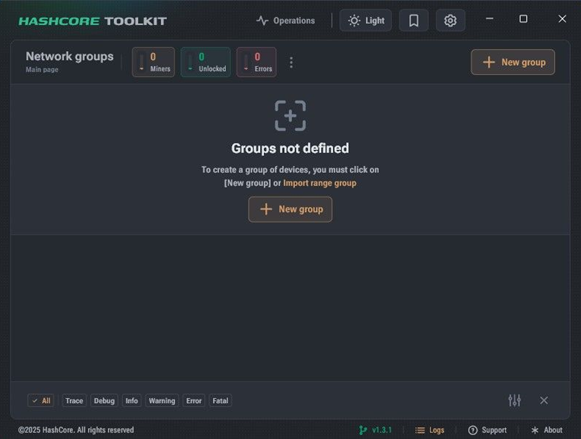
Centralized utilities such as hashcore toolkit can fit into a workflow where firmware operations need to be coordinated across multiple ASIC miners. The ability to work with groups saves considerable time, but speed should not determine the update strategy. Large deployments need checkpoints that allow an operator to discover an incompatibility before it reaches the rest of the fleet. The safest approach is therefore staged rather than simultaneous. Each stage should produce enough information to decide whether the next group is ready to proceed.
Compatibility Comes Before Installation
An ASIC model name is not always enough to determine which firmware file should be installed. Miners sold under the same product family can use different control boards, hardware revisions or factory software versions. A firmware package intended for one configuration may not be suitable for another even when the machines look identical from the outside. For that reason, an inventory check should precede every large update. The operator needs to know exactly what equipment is being selected before any file is sent to it.
Control board type deserves the same care as the miner model. Firmware interacts directly with the hardware platform responsible for running the miner, so differences in processor architecture or board revision can change the installation procedure. Factory firmware can also impose restrictions that affect how another firmware package is installed or whether a downgrade is required first. Assuming that every machine in a rack has the same internal configuration is risky, especially in farms that have expanded over several purchasing cycles. Replacement control boards may introduce further variation that is not visible in the original purchasing records.
Before starting a deployment, it is useful to record a compact set of baseline information:
- exact ASIC model and hardware revision where available;
- control board type and current firmware version;
- IP address, worker name and physical location;
- pool configuration and current performance profile;
- normal hash rate, temperature and power consumption;
- the firmware package selected for the update and its source.
This record serves two purposes. First, it helps prevent incompatible devices from being included in the same batch. Second, it creates a reference point if performance changes after the update. Without a baseline, an operator may notice that a miner is behaving differently but have no reliable way to determine which setting changed. Good firmware maintenance begins before the installation button is pressed.
Firmware files themselves should also be treated as controlled technical assets. They should come from the developer or another trusted distribution channel, and the operator should confirm that the package corresponds to the intended miner and installation method. File names are useful clues, but they should not replace documentation. If several firmware builds are stored in the same maintenance folder, clear organization reduces the chance of selecting the wrong package under time pressure.
Test the Update on a Small Pilot Group
A full-farm rollout should rarely be the first test of a new firmware version. A better approach is to select one miner or a small group that represents the hardware intended for the larger deployment. The pilot should use the same model, control board and existing firmware state as the machines that will follow. If several hardware variants are present, each meaningful variant needs its own test. A successful installation on one configuration does not prove compatibility with another.
The purpose of the pilot is not simply to confirm that the miner reboots. The device must return to the network, load its expected configuration and resume stable hashing. Pool connectivity should be checked along with worker identification, because a miner can appear healthy locally while sending work to an unintended account or failing to submit shares correctly. Temperatures and fan behavior should also be observed after the machine reaches a normal operating load. A firmware update that installs successfully but creates unstable operation has not passed the test.
Performance should be compared with the baseline rather than judged from a single number immediately after startup. ASICs often need time to settle after a restart, and short-term hash-rate readings can fluctuate. The operator should allow enough time to see whether the miner maintains expected output without repeated reboots, board errors or thermal problems. If the firmware changes tuning behavior, power consumption also needs to be considered. Higher hash rate is not automatically an improvement if the additional output requires disproportionately more electricity.
The pilot phase is also the best time to discover procedural problems. Perhaps the installation takes longer than expected, a network setting needs to be restored manually or a particular hardware revision requires a different package. Finding that issue on two machines is inconvenient. Discovering it after updating two hundred machines can stop production across a significant part of the farm.
A pilot should have explicit acceptance criteria. The operator should know what counts as a successful result before the test begins rather than deciding after seeing the outcome. Stable connectivity, expected hash rate, acceptable temperatures, correct pool configuration and the absence of recurring hardware errors provide a practical basis for that decision. If any of those conditions fail, the larger rollout should remain paused until the cause is understood.
Roll Out Firmware in Controlled Batches
Once the pilot has passed, there is still little reason to update the entire fleet simultaneously. Batch deployment preserves the efficiency of centralized management while limiting the number of miners exposed to an unexpected problem at any one time. The size of each batch can depend on farm capacity, staffing and the importance of keeping a certain proportion of the fleet online. A facility with several thousand ASICs can tolerate a different maintenance pattern from a small operation where every offline machine represents a substantial share of total hash rate.
Staggered updates also make infrastructure behavior easier to observe. Reboots change network activity and electrical load, while miners returning to full performance can alter heat production in a short period. Updating equipment in sections gives cooling and electrical systems time to respond rather than creating one large transition. It also helps technicians identify where a problem began. If an error appears only after a particular batch, the affected group can be isolated without questioning the state of every miner on the site.
Device grouping should follow technical compatibility rather than physical convenience alone. Two neighboring racks may contain different revisions purchased at different times, while identical miners may be distributed throughout the facility. The deployment structure should reflect firmware requirements first and location second. This reduces the chance that a convenient rack-level selection accidentally combines machines that need different packages.
The operator should verify each batch before moving to the next. An update console may report that an operation completed, but that status does not confirm long-term mining stability. Devices need to be rescanned or otherwise checked after they return, and their pool-side activity should be compared with local monitoring. A sudden reduction in accepted work can reveal a problem that the installation process itself did not detect. Each completed batch should therefore pass the same essential checks as the pilot, even if the observation period is shorter.
There is also value in leaving a small number of unchanged miners available for comparison during the rollout. If updated devices begin showing different temperatures, error rates or power consumption, the control group provides immediate context. This is especially useful when environmental conditions are changing at the same time. Without a comparison, a temperature increase caused by warmer intake air could easily be attributed to the new firmware.
Watch the Miners After the Update
The first successful reboot is only the beginning of post-update monitoring. Some problems appear immediately, while others become visible only after the ASIC has operated under load for several hours. A board may start normally and later become unstable. Fan control can behave correctly at startup but respond poorly when ambient temperature rises. Pool connections may also reveal intermittent problems that cannot be detected during a brief maintenance check.
Hash rate should be evaluated alongside hardware errors and stability. If output rises but the miner begins restarting regularly, the apparent improvement may disappear once downtime is included. The same principle applies to aggressive performance profiles. A higher reported rate has little value if it creates rejected work, excessive temperatures or shortened periods between failures. The useful measurement is sustained production under acceptable operating conditions.
Temperature trends are particularly informative when many similar miners are compared. If one updated unit runs hotter than its unchanged peers, the device itself deserves inspection. If an entire updated batch shows the same difference, the firmware configuration may be responsible. If both updated and unchanged machines become hotter together, environmental conditions are a more likely explanation. Fleet-level monitoring makes these distinctions easier than examining each ASIC in isolation.
Pool-side statistics provide another independent check. Local interfaces report what the miner believes it is producing, while the pool shows whether useful work is actually being received. The two values will not always match exactly over short periods, but persistent discrepancies deserve investigation. Worker names should also be checked after configuration changes so that production is not accidentally assigned to the wrong account or worker record.
Monitoring should continue long enough to capture normal operating variation. A five-minute inspection can confirm that a miner has restarted, but it cannot establish that the new firmware is stable through changing temperatures and workload conditions. The required observation period depends on the scale and risk of the deployment. Higher-risk changes justify a slower rollout because the cost of discovering a defect late can be much larger than the cost of delaying the next batch.
Keep a Recovery Path Available
Firmware maintenance needs a recovery plan before problems occur. The previous firmware version, installation procedure and original configuration should remain accessible until the new deployment has proved stable. If an update fails on a specific hardware variant, technicians should not have to search for old files while part of the farm is offline. Preparation turns rollback into a planned maintenance action rather than an emergency improvisation.
Recovery is not always as simple as reinstalling an earlier package. Factory restrictions, control board differences and changes introduced by newer software can affect the available procedure. This is another reason to research compatibility before the rollout rather than after a failed installation. The recovery method should be appropriate for the exact hardware and firmware combination being updated. If physical access to a control board could be required, that possibility should be understood before remote maintenance begins.
Configuration backups are equally useful. Pool addresses, worker information, network parameters and performance settings may need to be restored after firmware replacement or reset. Keeping those details outside the miner prevents a hardware or software failure from becoming an information-loss problem as well. The backup should be readable by technicians without relying on the affected device. A configuration stored only inside an inaccessible miner provides little protection.
Documentation also improves future updates. Recording which batches were updated, which firmware they received and what problems occurred creates a practical history of the fleet. The next maintenance cycle can use that history to identify troublesome hardware revisions or procedures that required additional steps. Repeated firmware work then becomes more predictable because decisions are based on the farm’s own operating experience.
Safe deployment is not defined by how quickly firmware reaches every ASIC. It is defined by how little uncertainty remains as the rollout expands. Compatibility checks reduce the chance of selecting the wrong target, pilot testing exposes problems on a manageable scale, and batch deployment limits the reach of unexpected failures. Post-update monitoring confirms that successful installation has translated into stable mining. A recovery path protects the farm when it has not.